

Key Takeaways
- The best family game is usually the one that the youngest regular player can understand and enjoy.
- Reading level, attention span, player count, setup time, and game length matter as much as the age printed on a box.
- Short games and flexible rules can help younger children participate while still giving older players meaningful choices.
- Cooperative games can be a strong option when large age gaps or frustration with losing make competition difficult.
- Games can give children opportunities to practice math, language, planning, turn-taking, and social communication.
A successful family game night does not depend on finding the most complicated game on the shelf. It depends on choosing a game that lets the people at your table participate, make choices, and enjoy the time together. Families looking for board games the whole family can learn from can explore SimplyFun’s family game collection, which organizes tabletop options by age, player count, skill area, and accessibility considerations. SimplyFun focuses on educational and family games for home game nights, classrooms, and other group settings, making its focused collection a useful reference point when comparing games for mixed-age players.
Why Mixed-Age Game Night Can Be Tricky
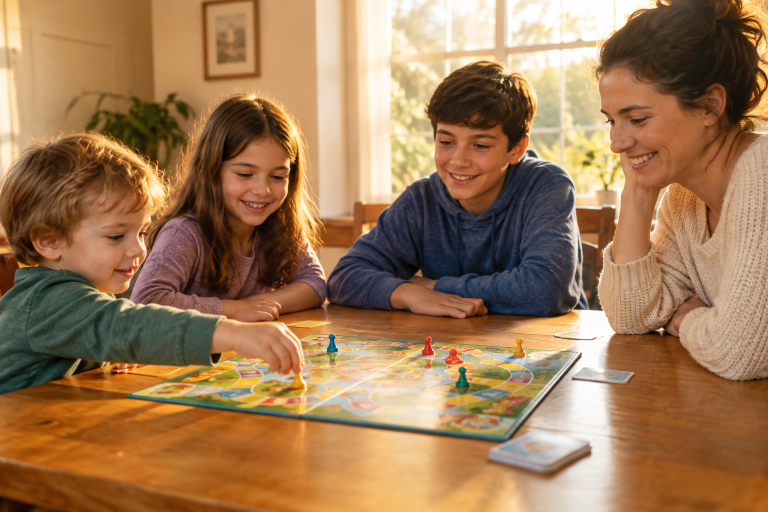
A game that feels easy and quick to a 10-year-old can feel confusing or slow to a 4-year-old. Long waits between turns, dense instructions, small print, complicated scoring, and advanced strategy can make younger players disengage. At the same time, a game with no decisions may leave older children feeling bored. Consider a family with a preschooler, an elementary-age child, and a preteen. The goal is not to create perfectly even competition. It is to choose a format where each person has something useful to do and a reasonable chance to stay involved from beginning to end.
Start With the Youngest Regular Player
Use the youngest regular player to set the game’s basic difficulty level. Older children and adults can often handle a simpler game, especially when there are optional challenges or opportunities to help teach. Younger children may not yet be ready for long-term planning, independent reading, or extended focus.
Questions to Ask Before Buying
- Can the youngest player understand the goal in a sentence or two?
- Can they move the pieces, sort cards, or roll dice independently?
- Does the game require reading, math facts, or memory skills beyond their current level?
- How long can they remain engaged before they need a break?
- Can the rules be simplified without changing the game’s main purpose?
Match the Game to Age and Skill
Preschool Players
Look for clear pictures, sturdy pieces, matching, simple counting, colors, and predictable turns. Sessions of about 10 to 20 minutes are often easier to finish successfully. Games with little or no reading can help children focus on turn-taking and following a simple sequence.
Early Elementary Players
Children in this stage may enjoy basic strategy, pattern recognition, storytelling, simple addition, and light deduction. Choose games that allow real decisions, such as selecting a card, choosing a path, or deciding when to use a limited resource. A 15- to 30-minute game is often a practical fit.
Older Children and Teens
Older players may be ready for planning, probability, wordplay, deduction, and changing strategies. They can also make a simple game more engaging by taking on optional challenges, tracking advanced scoring, or helping younger players understand a turn without taking control of it.
Use Play Time as a Practical Filter
Game length affects whether a game actually reaches the table. A longer strategy game may work well on a weekend, while a school night may call for a faster choice.
- 10 to 15 minutes: Useful for young children, visiting relatives, travel, or a quick warm-up.
- 20 to 30 minutes: A comfortable middle ground for many families.
- 45 minutes or more: Better suited to players who enjoy deeper planning and can stay focused longer.
Before choosing, check whether the game has a shorter mode, a simple setup, or a natural stopping point between rounds.
Choose Cooperative or Competitive Play
Cooperative games ask everyone to work toward the same result. They can reduce the pressure of direct competition and give adults a natural way to model planning, listening, and problem-solving. They may work especially well when players have a wide age gap or when one child finds losing difficult. Competitive games can also be rewarding when turns move quickly, and every player gets meaningful choices. Focus praise on patience, creative decisions, and gracious behavior, rather than only on who wins. A close finish is not required for a game to be enjoyable.
Look for Skills Hidden Inside the Fun
Games do not need to feel like school to offer practice with useful skills. Counting spaces, comparing totals, and adding points can create natural math moments. A review of number-based board game research discussed by the University of Oregon found that these games can support early number knowledge, including counting and number recognition.
- Math: Counting, comparing quantities, adding scores, and considering chance.
- Language: Reading, vocabulary, storytelling, and explaining choices.
- Executive function: Remembering rules, planning, changing strategies, and waiting.
- Social skills: Listening, turn-taking, cooperation, and recovering after disappointment.
- Spatial thinking: Matching shapes, building patterns, and reading a board layout.
Consider Social, Emotional, and Sensory Fit
Choose games that suit the family’s mood as well as each player’s comfort level. Some children enjoy fast, noisy action, while others do better with calm pacing and clear expectations. Research described by Harvard’s Faculty of Arts and Sciences found that structured social-cognition games helped preschool participants recognize emotions and reason about other people’s perspectives.
- Choose visual cues and limited text when reading is still developing.
- Use team play if one child regularly becomes upset about losing.
- Allow extra processing time before asking for a decision.
- Check piece size, color contrast, noise level, and the amount of fine motor control required.
- Avoid formats where one confident player can make every decision for the group.
Build in Flexible Rules
Small adjustments can make one game work for a wider range of ages without removing the fun. Read cards aloud for new readers, pair a younger child with an older teammate, shorten the winning goal, or give older players an optional scoring challenge. Give younger players a modest advantage only when it helps them remain involved. House rules should invite participation, not turn one player into the manager of everyone else’s game.
Check Player Count, Space, and Replay Value
Confirm that the game supports the number of people who will usually play. A true two-player game can be ideal for siblings or a parent-child pair, while a larger family needs a format that keeps everyone active. Also consider whether the board, cards, and pieces fit the available table space. Finally, prioritize replay value over novelty. A simple game with changing cards, different layouts, multiple paths to success, or beginner and advanced modes is more likely to return to the table. The best choice is the one that fits your family’s current abilities, leaves room to grow, and gives everyone a reason to ask for another round.
Conclusion
A great family game night starts with choosing a game that everyone can enjoy, especially the youngest regular player. Consider age, reading ability, attention span, game length, and whether cooperative or competitive play better suits your group. Flexible rules and age-appropriate challenges can help children of different abilities participate while practicing useful skills such as communication, planning, and problem-solving. SimplyFun’s family game collection offers options organized by age, player count, skill area, and accessibility, making it a helpful starting point for comparing games. Ultimately, the best choice is one that brings everyone to the table and makes them want to play again.

Meg is an author at Cinnamon Hollow. She writes on a variety of topics sharing tips and ideas for daily life.