You check the answer three times. The algebra looks fine. The substitution seems correct. Then you spot it — one missing negative sign halfway through the page. Suddenly, the entire solution collapses.
That tiny mistake is painfully familiar to Calculus students.
Digital integration tools help students learn faster by providing immediate feedback, detecting calculation errors, visualizing functions, and explaining complex techniques step by step. Instead of spending hours searching for small algebra mistakes, students can focus on understanding calculus concepts and building problem-solving confidence.
Calculus II has a reputation for a reason. It’s not usually one impossible idea that causes trouble. It’s the accumulation of many ideas at once: antiderivatives, trigonometric identities, limits, substitution methods, partial fractions, and symbolic notation all competing for attention on the same page.
That’s why more students now use verification-based learning tools like integral calculator alongside traditional coursework. Modern integration platforms are designed not only to provide answers, but also to explain why each step works.

Why Students Struggle with Integral Problems
Before looking at the advantages of digital tools, it helps to understand why integration becomes difficult so quickly.
Unlike derivatives, which often follow predictable rules, integration requires decision-making. Students must identify which technique applies before solving anything. Should you use:
- u-substitution?
- integration by parts?
- trigonometric identities?
- partial fractions?
- improper integral testing?
One wrong choice can waste twenty minutes.
Even strong students struggle with symbolic manipulation under time pressure. Research-based educational platforms increasingly emphasize guided, step-by-step learning because students retain concepts better when they can compare their own reasoning against structured solutions.
- Verifying Manual Steps and Locating Errors Quickly
Most calculus mistakes are not conceptual failures. There are mechanical errors.
- A missing exponent.
- A dropped parenthesis.
- A forgotten differential.
- An incorrect sign.
These tiny mistakes can completely derail an otherwise correct solution.
An integral calculator works like a second reviewer. Students can compare every transformation against their handwritten work and immediately identify where the process went wrong. That changes how people study.
Instead of repeatedly solving entire problems from scratch, students isolate the exact moment an error appeared. This kind of targeted correction improves retention much faster than simply checking a textbook answer at the back of the chapter.
Several online platforms specifically highlight intermediate algebraic steps to help students diagnose mistakes efficiently.
- Breaking Down Complex U-Substitution Patterns
At the beginning of Calculus II, substitution seems manageable:
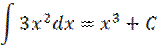
Then, instructors introduce nested exponentials, logarithms, and trigonometric functions together.
Students suddenly face expressions like:
Recognizing the inner derivative becomes difficult under exam pressure.
The Online Integral Calculator slows the process down visually. It identifies:
- the substitution variable
- the derivative relationship
- the rewritten integral
- the back-substitution step
That structure trains pattern recognition naturally over time.
Instead of memorizing isolated examples, students begin understanding why certain substitutions work.
- Handling Tedious Partial Fraction Decomposition
Few topics frustrate students more than partial fractions.
The calculus itself may not even be difficult. The problem is the algebraic overhead.
Take this example:
Before integrating anything, students must:
- decompose the rational expression
- solve for coefficients
- simplify multiple fractions
- integrate each component separately
One arithmetic mistake ruins everything downstream.
Modern symbolic solvers dramatically reduce this burden by automating decomposition steps while still displaying the underlying logic. Advanced calculators can also explain the coefficient-matching and denominator-separation methods in detail.
- Visualizing the Area Under a Curve for Definite Integrals
Many students treat definite integrals as purely symbolic procedures.
That’s a problem.
When learners see:
They often focus only on evaluation mechanics instead of understanding that the integral represents accumulated area.
Interactive graphing changes immediately.
Visualization tools shade the region beneath the curve, helping students connect geometric intuition with algebraic procedures. They can literally see how limits affect the accumulated area.
This becomes especially valuable when studying:
- positive and negative regions
- symmetry
- improper integrals
- accumulation behavior
Graph-supported learning tools are increasingly common in online calculus platforms because visual reinforcement improves conceptual understanding.
- Mastering Trigonometric Identities Without Burnout
Trig integrals can feel relentless.
Students must remember identities like:
while simultaneously deciding which identity simplifies the integral most effectively.
That cognitive load creates memorization fatigue.
Using the Online Integral Calculator as a verification companion helps students absorb identities through repeated exposure instead of last-minute cramming. Over time, common transformations become recognizable patterns rather than isolated formulas.
And honestly, that’s how most people actually learn calculus.
Not through memorization alone.
Through repetition and correction.
- Checking Improper Integrals for Convergence
Improper integrals introduce another challenge: limits at infinity.
Consider:
Students must:
- compute the antiderivative,
- apply limits correctly,
- determine convergence behavior.
That’s a lot happening simultaneously.
Step-by-step solvers help by separating each stage clearly. They demonstrate how limits are evaluated and explain why certain integrals converge while others diverge.
Some advanced tools even identify the integration technique automatically before presenting the solution process.
7. Automating the Constant of Integration (+C) Check
It sounds small, but forgetting (+C) is one of the most common calculus mistakes.
Students often complete the antiderivative correctly and still lose points because the constant of integration is missing.
Repeated exposure matters here.
Students gradually internalize the habit. Educational calculators increasingly distinguish clearly between definite integrals and indefinite antiderivatives for this exact reason.
8. Bridging the Gap Between Derivatives and Antiderivatives
Many students memorize derivative formulas mechanically without understanding the inverse relationship behind integration.
For example:
and therefore:
When students repeatedly compare derivatives and antiderivatives side-by-side, the connection becomes intuitive.
The Online Integral Calculator is especially helpful here because learners can instantly test whether their antiderivative differentiates back to the original function.
That feedback loop strengthens conceptual understanding dramatically.
9. Rapidly Evaluating Limits of Integration
Even after students solve the integral correctly, bound evaluation creates new opportunities for mistakes.
Take:
The integration itself is straightforward. The arithmetic evaluation is where many students slip.
Verification tools reduce wasted time by instantly checking substitution accuracy and limiting evaluation. This allows students to focus more attention on strategy and less on repetitive recalculation.
That efficiency matters during timed exams.
10. Reducing Math Anxiety Through Secondary Verification
A large portion of calculus frustration comes from uncertainty.
Students constantly wonder:
- “Did I simplify correctly?”
- “Was that the right substitution?”
- “Did I forget a negative sign again?”
That uncertainty builds stress quickly.
Using the Online Integral Calculator as a secondary verification tool lowers that anxiety significantly. Students gain confidence because they can confirm their reasoning before reinforcing incorrect habits.
And confidence changes performance.
Reddit discussions among calculus students repeatedly mention answer verification as one of the biggest practical advantages of integration tools, especially during long homework sessions.
Manual Calculation vs Calculator-Assisted Learning
| Factor | Manual Calculation | Calculator-Assisted Learning |
| Speed | Slower for lengthy symbolic manipulation | Faster feedback and verification |
| Accuracy | Higher risk of algebra mistakes | Immediate error detection |
| Learning Depth | Strong conceptual practice but time-intensive | Faster pattern recognition when used responsibly |
| Visualization | Usually abstract | Graphs reinforce geometric understanding |
| Confidence | Can decrease after repeated mistakes | Encourages self-correction |
| Retention | Depends heavily on repetition | Improved through guided verification |
The Pedagogy of Verification
There’s a productive way to use calculus tools, and there’s an unproductive way.
The unproductive way is obvious: copy the final answer and move on. This approach teaches almost nothing.
The better method is verification-based learning.
- Solve the problem manually first.
- Then compare your work against the generated solution.
- Study the substitution logic.
- Examine the algebraic simplifications.
- Analyze the mathematical notation carefully.
Educational research increasingly supports guided feedback systems because students learn more effectively when they actively compare reasoning processes instead of passively reading solutions.
The goal isn’t to replace critical thinking.
It’s strengthening it.
FAQs
Does an integral calculator explain every step?
Most advanced systems now provide full step-by-step explanations, including substitution logic, partial fractions, trigonometric simplifications, and integration techniques. Some even identify which method is being used automatically.
Can these tools solve difficult trigonometric integrals?
Yes. Modern platforms support trigonometric identities, inverse trig functions, hyperbolic functions, and advanced substitution techniques commonly taught in Calculus II courses.
What’s the difference between definite and indefinite integrals?
Indefinite integrals produce antiderivatives and include the constant of integration (+C). Definite integrals evaluate accumulated quantities between bounds using limits of integration and the Fundamental Theorem of Calculus.