
Stone Holding the Current
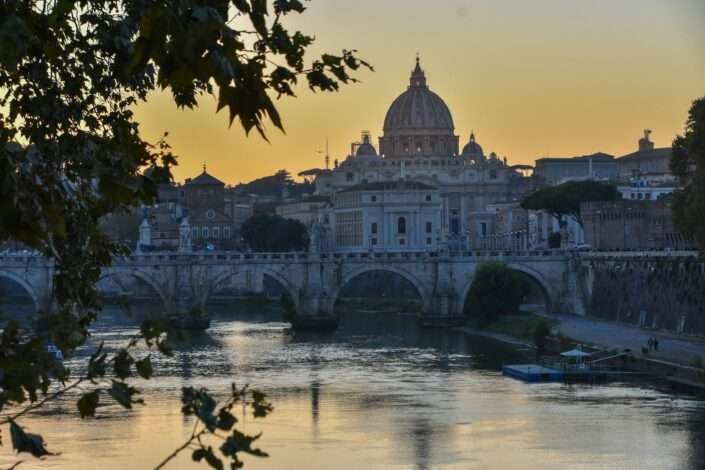
The Tiber does not move dramatically through Rome. It passes in a contained, almost reserved way, guided by high embankments that rise in steady walls of pale stone. The river sits lower than the streets, held in place by architecture that feels deliberate rather than ornamental. From above, the water appears muted green or brown depending on the light, reflecting fragments of bridge arches before carrying them away.
Walking along the Lungotevere, the sensation is less about water and more about distance. The embankments create a separation between city and river — a space that feels engineered, protective. Trees line the upper roads. Traffic hums overhead. Below, the current continues without commentary.
The bridges interrupt the repetition. Arches cross from one side to the other in measured intervals, each holding its own perspective of the city beyond. Light filters downward between stone edges and settles briefly on the surface before shifting again.
Between River and Hill
Rome rarely reveals itself all at once. The ground inclines gently toward the Seven Hills, though you only notice the slope after a while. Steps appear unexpectedly. Narrow streets bend around corners that seem older than their surroundings. The Tiber remains nearby but not always visible, hidden behind those steady embankments.
Later, travelling south aboard the train from Florence to Rome, the approach to the capital feels gradual. Fields give way to clustered suburbs, then to stone layered upon stone. The movement slows slightly before arrival. The station opens into a city already in motion.
Returning to the river in memory, the embankments feel less like barriers and more like frames. They hold the water in place while allowing the city to rise above it. The arrangement appears intentional but not decorative — stone guiding current, current slipping quietly past.
Nothing insists on spectacle. The river does not overflow. It remains contained, steady beneath bridges that have seen centuries pass.
Gold Beneath the Sky
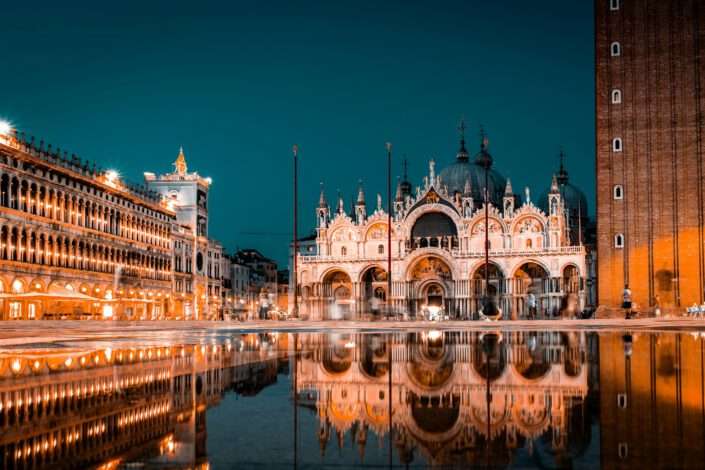
In Venice, water meets architecture without separation. The city does not hold its canals at arm’s length. They enter directly beneath windows and along foundations. Yet St. Mark’s Square offers a different relationship — stone paving stretching outward in wide, open measure, framed by arcades and domes.
The façade of the basilica carries mosaics that shift under changing light. Gold tesserae catch brightness in fragments, reflecting it unevenly. From a distance, the images seem flat. Up close, they fracture into tiny pieces of glass and stone, arranged in patient detail.
Arriving after a journey on the train from Florence to Venice, the transition feels almost theatrical but not hurried. The mainland recedes. The lagoon opens. Then the square appears — expansive, echoing with footsteps, bordered by façades that hold centuries in layered ornament.
Pigeons gather and disperse. Shadows lengthen across the paving stones. The mosaics glow briefly in late afternoon before softening into dusk.
Edges and Surfaces
The Tiber’s embankments create distance. St. Mark’s Square invites immersion. One contains water firmly; the other stands exposed to tide and sky. Yet both speak in stone. Both rely on repetition — blocks stacked in even courses along the river; tiny tesserae assembled into shimmering scenes above Venetian doorways.
In Rome, the eye travels horizontally along embankment walls before lifting toward domes and rooftops. In Venice, the gaze moves upward immediately, drawn to arches and mosaics catching light. The materials differ — travertine and granite against glass and gilded tile — but the persistence of form remains.
Neither space seeks resolution. The river continues beneath its bridges. The square fills and empties according to hour. Light behaves differently in each place but carries the same quiet insistence on change.
After the Reflections Fade
Later, recalling both settings, the details soften. The embankments lose their precise alignment. The mosaics become fields of gold rather than individual figures. What remains is the sense of stone meeting water in different ways — one through containment, the other through proximity.
The river keeps its steady pace beneath the city. The square continues to hold light in fractured glints. Movement persists somewhere beyond view, connecting north and south through rail and memory.
And between them, the sense of era does not divide cleanly. Ancient forms rest beside later additions. Surfaces weather slowly. The water shifts again, touching stone before moving on, leaving both cities quietly intact in its wake.
Where Water and Stone Continue Quietly
Even after leaving, the sensation does not separate into river or square. It lingers somewhere between vertical wall and open paving, between contained current and exposed tide. The Tiber moves in recollection as a low, steady presence beneath bridges that no longer feel fixed to any one century. The mosaics shimmer faintly behind closed eyes, less as images and more as texture — small fragments catching stray light. Neither space resolves into lesson or hierarchy. The embankments remain firm without feeling rigid. The square remains luminous without demanding attention. And somewhere between them, water keeps passing stone in different ways, repeating the same gesture with slight variation, as if history itself were moving slowly past the edges, never fully stopping, never entirely leaving.
Check out our Travel Adventure videos below!