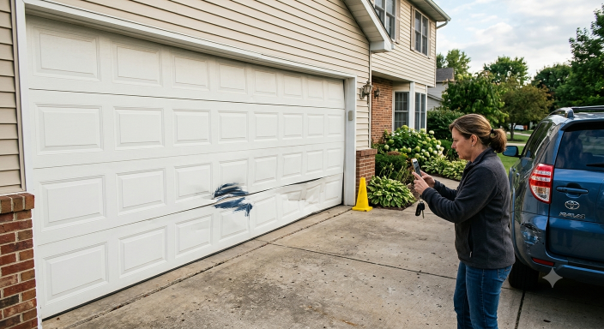
What should actually happen in the ten minutes right after a car clips your garage door? Speed isn’t what matters most here; caution is. In the moment there is contact made, the stress load on the car door changes, even though at first glance it may not appear to be an issue of concern at all. There could potentially be torsion springs, tracks, and cables that have endured stress and are now under pressure.
First Things First: Is It Safe to Approach the Door?
Before you touch a panel, reach for the remote, or flip a wall switch, pause and take a careful look. Resist the urge to hit the opener just to “see what happens.” If the door is sitting partway open, treat it as inherently unstable — a track under stress or a compromised spring could shift or drop with no notice, so it’s best to call Grand Valley Garage Doors before attempting anything further.
Keep an eye out for: a track that’s bowed outward, a panel pressed inward, cables that look loose or frayed, or any visible gap between the door and its track. Spotting any of these means keeping people and animals well clear, and never attempting to force the door up or down.
Myth vs. Reality: “It’s Just a Dent”
The assumption: a dented panel is purely cosmetic, something that can sit unaddressed or simply be popped back into shape.
The reality: a garage door functions as a carefully balanced mechanical system. Every panel has a purpose in keeping the door stiff structurally and thus ensuring that the door remains in shape inside the track. If any panel develops a dent, the balance of weight distribution on the rollers and hinges changes, causing damage to the motor, straining the springs, or derailing the door completely. This implies that in most cases, a dent may not just be a cosmetic problem but also indicate an underlying structural problem.
The Step-By-Step Response Sequence
Here’s the recommended order of operations.
- Secure and document. Cordon off the area so nobody walks or drives beneath the door. Take photographs of the damage from several angles, capturing the track and hardware as well — these images matter both for accurate diagnosis and for any insurance claim you might file.
- Assess. Without attempting to operate the door, check whether it sits level within both tracks. When there is a sag in the door on one side only, then this indicates spring or cable failure, not just panel failure.
- Protect. If the door is not fully open, put up cones, sawhorses, or some other barrier. You cannot use a stick or board to prop the door open, because it poses a hazard of falling.
- Call a pro. Contact a certified technician to have your problem diagnosed before attempting to move the door. An expert will be able to tell the difference between something that is merely bent, crooked, or actually broken.
Common Damage Patterns and What They Signal
A lone dented panel on a door that continues tracking smoothly is frequently resolved with a straightforward panel swap. A bent track, on the other hand, throws the rollers out of alignment, which can cause binding or derailment and typically calls for repair or full replacement. A door that sags signals cable or spring involvement and warrants inspection before any further use. And if the door refuses to budge while the opener motor is clearly running, that usually points to a broken spring — never attempt to force it; bring in a professional for an accurate diagnosis.
Repair or Replace? How to Decide
Factor in the door’s age — a unit already nearing the end of its service life may not justify piecemeal repairs. Weigh how much of the structure is affected — a single panel is a very different situation than damage reaching the track or springs. Make sure that you have coverage, as this sort of damage can be insured under either an auto policy or a homeowner’s policy. Also, make sure that you actually get a price quote and do not just make an educated guess.
DIY Quick-Fix vs. Professional Diagnostic Approach
Going the DIY route costs less initially, but it often ends up costing more down the line due to recurring issues, and it carries greater risk since working with spring and cable tension without proper training is genuinely dangerous. It’s also confined to whatever damage is visible and may end up voiding your warranty. A professional diagnostic runs a bit higher upfront but proves more economical over the long haul, delivering a comprehensive system inspection, warranty protection that stays intact, and documentation that strengthens any insurance claim.
How Professional Garage Door Service Supports Homeowners
A qualified technician brings more to the table than a simple panel replacement — the visit generally involves a thorough inspection of springs, cables, tracks, and opener alignment, since the stress from a vehicle impact often extends well beyond the point of contact. Most service companies will provide a document that homeowners can give to their insurers, who will tell them whether fixing is better than replacing altogether.
Key Points to Remember
- Hold off on operating the garage opener until the door has undergone a visual assessment.
- Capture photographs of all damage before anything gets moved.
- A door sitting unevenly likely points to spring or cable involvement — proceed with caution.
- Even a simple-looking dent can signal deeper structural stress.
- Secure a professional diagnostic before making any decisions, and hang onto your documentation.
Final Thoughts
Vehicle damage to a garage door is jarring to discover, but responding well doesn’t require complexity — it requires method. Creating security around the situation, reporting on what transpired, and avoiding the temptation to either lock or unlock the door helps secure your physical safety as well as your finances. Depending upon whether the eventual outcome will be a new panel or a whole new door, it becomes essential to work with a trusted company like Grand Valley Garage Doors.
FAQs
Is it safe to use the opener after impact? Not until the door has received a visual inspection — running it blindly risks compounding the damage.
Will insurance cover this kind of damage? Frequently, of course, especially if the damages are well documented. The actual coverage will depend on your policy details.
Can I differentiate between the two types of repairs? Look for symmetry — a door that sits level and moves smoothly once tested is usually the easier fix. Sagging or uneven movement points toward a bigger problem.