Variegated thread looks like the easiest shortcut in embroidery. One skein, several shades, instant depth without changing needles.
Then you stitch a small leaf and it comes out one flat colour, because the colour change happened somewhere in the length you did not use.
That is the whole problem with variegated thread, and it is solvable once you understand what actually causes it.
Why colour-change length decides everything
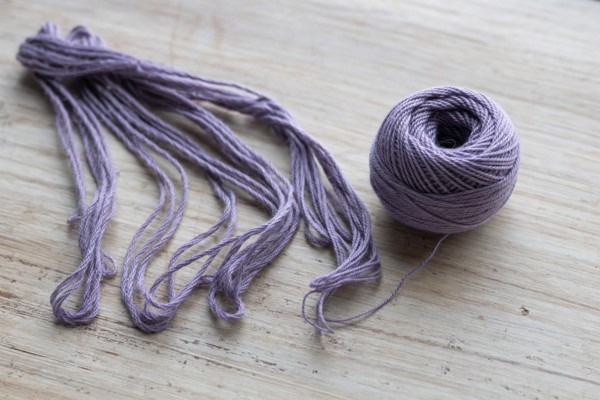
Every variegated thread has a repeat, meaning the distance the thread travels before returning to its starting shade.
A long repeat suits large areas. Filling a sky, a wide leaf or a background band gives the thread room to move through its full range, and the shift reads as intentional shading.
A long repeat ruins small details. A french knot, a single petal or two centimetres of stem stitch might sit entirely inside one shade. You bought variegated thread and stitched a solid colour.
A short repeat suits everything else. When the change happens over a few centimetres, even a tiny motif shows movement.
This is the single most useful thing to check before buying, and most packaging does not tell you. Cottage Garden Threads specifically describes short colour changes with seamless blends, designed so the variegation shows even when you are stitching small details. That is a deliberate manufacturing choice rather than a happy accident.
The re-threading problem
Here is the frustration nobody warns you about.
You finish a length mid-flower, load a new one, and the colour jumps. The new length starts at a different point in the repeat, so your smooth gradient has a visible seam through it.
Some threads solve this and most do not.
The fix is having the same colour at both ends of a cut length, so when you reload your needle the colour continues rather than restarting. Cottage Garden Threads builds this into its pre-cut lengths deliberately, which is the kind of detail you only appreciate after fighting the alternative.
If your thread does not do this, the workaround is to unwind and match by eye before cutting. It works and it wastes thread.
Stranded or perle, and why it matters more with variegated
The choice changes the effect, not just the thickness.
Stranded cotton separates into six strands. With variegated thread this creates an option solid thread does not have: strands pulled from different points in the repeat, recombined, give you a blended tweed effect. Pull them from the same point and you keep clean shading.
That is worth experimenting with on a scrap before committing.
Perle is a single twisted thread you cannot divide. You stitch it straight from the length, and the colour change is exactly what the manufacturer made. Perle 8 is fine enough for lettering and outlines. Perle 12 is finer still.
Cottage Garden Threads supplies stranded in pre-cut 50cm lengths and perle in 15m continuous lengths, which suits how each is actually used. Stranded gets cut and separated. Perle gets stitched off the ball.
Test before you commit
Two tests, five minutes each, and they save entire projects.
The stitch-direction test. Work the same motif twice, once completing each stitch fully before moving on, once working in rows. Variegated thread produces noticeably different results depending on stitch order, and neither is wrong. You just need to know which you are getting.
The daylight test. Stitch a small patch, then look at it in daylight and again under room light. Hand-dyed threads shift more than commercial solids, and a palette that sings at the window can go muddy under a lamp.
Buying enough of the right thing
Hand-dyed thread comes in dye lots, and lots vary.
Buy your full requirement at once for any area you want consistent. Coming back for one more skein three months later frequently produces a visible difference.
Buy the pack rather than singles where a design needs a coordinated palette. Curated sets remove the guesswork of matching values, which is the hardest part of colour planning for most stitchers.
Browsing embroidery threads by colour family and weight makes this manageable rather than overwhelming. Their range runs to hundreds of shades across a signature range and designer collections, filterable by colour and weight, with individual threads, duets and thread packs alongside each other.
For anyone planning a project palette, filtering by colour before browsing individual shades is considerably faster than scrolling a full catalogue.
Knots, and why good thread has fewer
Knotting is not entirely your technique.
Thread quality genuinely affects it. Long staple cotton, properly finished, resists the tangling that shorter fibres invite. Cottage Garden Threads describes a nine-step process from preparation to finished thread, specifically to produce high sheen and a low knotting rate.
Beyond the thread itself, three habits help.
Work with shorter lengths than feel efficient. Around 45cm is plenty. Longer lengths pass through fabric more times and abrade.
Let the needle dangle periodically to release accumulated twist. Every stitch adds a small amount of rotation and it compounds.
Thread the needle from the end that came off the skein first. Cotton has a direction, and going against it increases friction.
Storage that actually protects colour
Hand-dyed thread rewards decent storage more than commercial thread does.
Away from direct sunlight, which fades hand-dyed shades faster than you expect.
Separated rather than loose in a bin, because tangling is what makes people abandon half-used skeins.With the label attached. This matters more than it sounds, since matching a hand-dyed shade later without a number is close to impossible. Some packaging is designed for this, keeping the thread information with the thread as you use it.
Making things for other people
Variegated thread is particularly good for gifts, because the colour movement does a lot of visual work for relatively little skill.
A monogram in perle 12 looks considerably more accomplished in a variegated shade than a solid one.
A small hoop piece finishes in an evening and reads as far more involved than it was.
Anything for a baby wants soft tonal variation rather than high contrast, which variegated handles naturally.
If you are working through a list of handmade gifts, variegated thread is the shortcut that does not look like one. The same motif stitched in three different variegated shades produces three genuinely different pieces from one pattern.
A short buying checklist
Before you order, check five things.
Colour-change length, because it determines whether small details will show variegation at all.
Whether both ends of a length match, which decides how visible your re-threading points will be.
Format and length. Pre-cut stranded and continuous perle suit different working styles.
Weight. Six-stranded for adjustable thickness, perle 8 or 12 for consistent round stitches.
Whether a pack exists for the palette you need, since curated sets solve value-matching for you.
The honest summary
Variegated thread is not harder than solid thread. It just has one variable solid thread does not, and that variable is length.
Match the colour-change length to the size of what you are stitching. Test stitch direction before starting anything large. Buy your full requirement in one go. Keep the labels. Get those four right and variegated thread does exactly what you hoped it would when you first picked up the skein.

Hi, I’m Crystal – a Kentucky-based Aromatherapist, wife, mom and the voice behind The Cinnamon Hollow. I share cozy, real-life inspiration for healthier routines, simple home living, essential oil use and safety, beauty, pets, and family adventures. From everyday tips to travel guides, my goal is to help you create a warmer life and embrace each day as its own little adventure. Always remember to live life, one adventure at a time! read more