

A door handle that wiggles, spins, or slips in your hand is one of those small household annoyances that get louder the longer you ignore it. The good news is that most loose handles are a ten minute fix with tools that are already sitting in a kitchen drawer. The better news is that knowing why a handle loosens makes it much less likely to happen again.
So, what do I need for fixing a door handle? Direct Door Hardware, a door and cabinet hardware supplier that has been in business since 2003, answers that in its loose handle guide: a Phillips screwdriver, a flathead screwdriver (or a fingernail for prying off decorative covers), and an Allen wrench for set screws. That short list covers most repairs around the house.
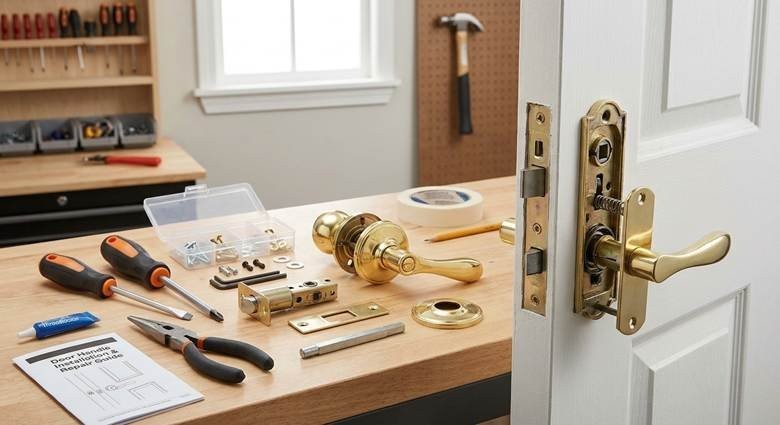
Why Handles Work Themselves Loose
Doors are used dozens of times a day, and every push and pull sends a little vibration through the hardware. According to Direct Door Hardware, loose handles usually result from mounting screws that slowly back out with daily use. Worn internal parts, such as the spindle or the mounting hardware, can also shift out of alignment, especially on high traffic doors. Screws that were not fully tightened at installation tend to loosen sooner than you would expect.
That helps explain why the handle on a busy door in a family home is often among the first to wobble.
Step by Step: From Tightening to Replacing
Start by working out which kind of handle you have. Exposed screw handles show their screws on the faceplate, while concealed screw handles hide them under a decorative cover. From there, Direct Door Hardware suggests working in this order:
- Tighten the mounting screws. Snug them evenly with a Phillips screwdriver and avoid overtightening. On a concealed handle, lift off the cover plate first.
- Tighten the set screw. Many lever handles have one, and it takes a screwdriver or an Allen wrench.
- Inspect for worn parts. If the handle is still loose, look for stripped screws, a worn spindle, or cracked plates, and repair or replace what you find.
- Replace the handle. If it keeps loosening, spins freely, or simply will not tighten, a new handle is the more durable answer. One small habit helps: turn each screw a little at a time rather than driving one all the way down before starting the next. Working evenly keeps the plate seated flat against the door.
A Quick Word About Older Homes
If you live in an older house, there is one more thing to consider before you start prying off plates. The U.S. Environmental Protection Agency notes that a home built before 1978 may have lead based paint, and it advises assuming the area does if you cannot tell the age of the home. For a simple tightening job, you may not disturb any paint at all. But if you need to scrape or sand around a plate, EPA’s do it yourself guidance includes misting surfaces first, using HEPA vacuum attachments, and wiping surfaces with wet disposable cloths until they come up clean. EPA also recommends a lead safe certified contractor for larger projects, so it is worth a phone call if the job grows beyond a handle.
Picking a Replacement That Actually Fits
When replacement is the right call, fit matters more than finish. Direct Door Hardware notes that most of its door hardware is designed to fit standard door preparation, and it points owners of nonstandard doors to a hardware replacement guide. Measure before you order, and note which way the door swings, because lever handles must be ordered as left handed or right handed to match the door.
If you are refreshing more than one door this year, it helps to check each one separately. In a house with a mix of older and newer doors, the handles are rarely interchangeable from room to room.
Questions People Ask Before Picking Up the Screwdriver
Why does my handle keep coming loose after I tighten it? A handle that will not stay tight is often telling you something is worn, such as stripped screws, a worn spindle, or cracked plates. If repairs do not hold, replacement is the fix.
Do I need special tools? Not for most handles. A Phillips screwdriver, a flathead screwdriver, and an Allen wrench cover the usual designs.
Can I overtighten a handle? Yes, and the guidance is to snug the screws rather than force them. Aim for a handle that sits firmly without feeling stiff.
Keeping Every Door in the House Working
Taken together, a loose handle is less a mystery than a maintenance reminder. Check the screws, tighten the set screw, look for worn parts, and replace the handle when it stops holding. Along the way, take a minute to think about the age of your home before you scrape or sand anything around a plate.
With that in mind, it pays to keep a plain language reference nearby. Direct Door Hardware’s loose handle guide is a practical place to start for 2026 projects, and its broader selection of door and cabinet hardware gives you somewhere to turn when a repair turns into a replacement.

Meg is an author at Cinnamon Hollow. She writes on a variety of topics sharing tips and ideas for daily life.