The first time my son had a real pollen reaction, I thought he was getting sick.
He was four. His nose wouldn’t stop running, he was sneezing every few minutes, and he kept scratching at his arms and the back of his neck like the itch was something he could claw out. My wife and I did what most parents do — we gave him fluids, took his temperature, and waited for the “cold” to pass. It didn’t. Three weeks and one allergist appointment later, we finally had a name for it: severe allergies to tree pollen, grass pollen, and ragweed. Two years later, he’s six, and we know the drill — the runny nose, the sneezing fits, the itchy skin that flares up whenever the count climbs.
If you’ve been there, you know the feeling. It’s not a serious diagnosis in the medical sense — kids live with allergies all the time. But it’s a lifestyle diagnosis. Suddenly, every spring morning becomes a small decision tree. Should he go to soccer practice today? Can we eat dinner on the back porch? Is it safe to keep the windows open while he sleeps? Spring used to be the cozy season I looked forward to most. Now it was the season that made my kid miserable.
The morning that changed everything
About a year into our new reality, I was standing in our Louisville kitchen at 7 a.m., scrolling through three different weather apps, an air quality site, and a pollen forecast page that hadn’t updated since the day before. If you live in Louisville, you already know the deal — the whole city sits in the Ohio River Valley, which is great for sunsets and bourbon and absolutely terrible for allergies. Pollen rolls in and just sits here. My son was eating cereal in his pajamas. I was trying to figure out – based on five different numbers from five different websites – whether to send him to school in long sleeves or short, whether to let him ride his bike home, whether tonight was a night we could grill on the porch.
My wife walked in, watched me for about thirty seconds, and said, very gently: “You’re doing this every single morning. There has to be a better way.”
She was right. Nobody needs five tabs open before breakfast.
The tool I wished existed
That morning is the reason I built PollenTracker. I’m a product manager by day, so when my wife pointed out the problem, I did what product people do — I sketched out the simplest version of a fix on the back of a napkin. I needed one thing every morning: a single, clear answer to should we go outside today? Not “moderate-to-high tree pollen with elevated PM2.5.” Not a color-coded gauge that needs interpreting. Just one word.
PollenTracker pulls real-time pollen counts, AQI, and weather conditions for your zip code, then collapses all of that into one of three answers:
- YES – go outside, you’re fine. Windows open, recess outside, soccer practice.
- CAUTION – keep outdoor time short, shower the moment he’s home, watch for the itchy-skin tell.
- NO – plan an indoor day before he asks if he can ride his bike.
That’s it. No charts, no gradients, no cross-referencing five tabs at 7 a.m. Just the answer.
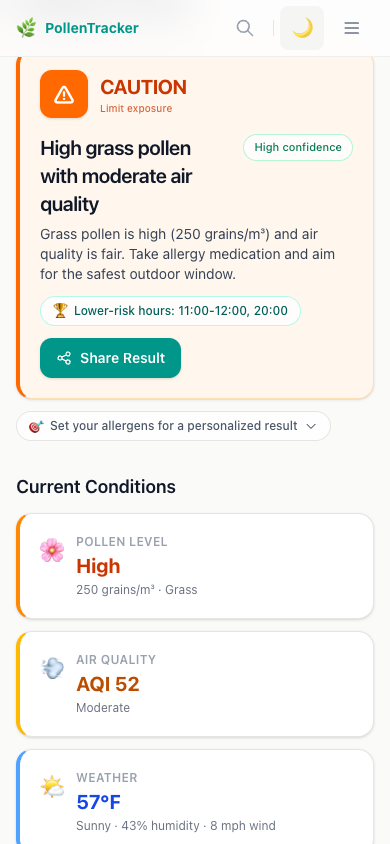
This morning’s reading from PollenTracker for Louisville. The whole point is that you don’t have to interpret anything — it just tells you.
It started as a personal tool, just for our family here in Louisville. I shared it with a couple of other allergy parents at my son’s school. Then their friends asked for it. Now it covers more than 800 US and UK cities – including most of Kentucky, so any of you reading this from Lexington, Bowling Green, or right here in Louisville can pull it up for your zip code in about ten seconds. And it’s still completely free, because if you’re in this club, you didn’t ask to join, and the last thing you need is another subscription.
What I learned along the way
Building the tool taught me a few things I wish I’d known earlier:
Pollen levels swing wildly through the day. A morning that starts “low” can hit “very high” by noon. Most parents think of pollen as a daily forecast, but it’s much more like weather — you want to check it the way you’d check rain before a hike. Counts typically peak between 5 a.m. and 10 a.m., which is exactly when most kids are walking to the bus stop.
Air quality and pollen aren’t the same thing. This one tripped me up for months. AQI measures pollutants like PM2.5 and ozone — things that affect everyone. Pollen counts measure plant allergens — things that affect a specific group. A “good air quality” day can still be a brutal pollen day, and vice versa. According to the AAFA, tree pollen peaks from March to May, grass pollen from May to July, and ragweed from August to October — so the worst weeks depend entirely on what your kid actually reacts to. (For my son, it’s all three. Lucky us.)
Tiny everyday changes matter more than you’d think. Closing windows during peak hours, leaving outdoor shoes at the door, washing his hair before bed instead of in the morning — none of it is fancy, but each small habit takes a little weight off his system.
Where essential oils fit into our cozy routine
I read Cinnamon Hollow regularly because Crystal writes the way I cook – with whatever’s in the pantry, no fuss, real life. Her essential oils corner of the internet is one of my favorite places to scroll through after a long workday.
For us, essential oils came into the picture during peak ragweed weeks, when my son’s nose gets so stuffy he can’t sleep. We started doing a quick pre-bed steam — a bowl of hot water on the kitchen table, a few drops of eucalyptus or peppermint, a towel over his head for two or three minutes. It buys him a few hours of better breathing on the worst nights.
I want to say very clearly: essential oils are a comfort tool, not a substitute for what his allergist recommends. We use them with the medical plan, not instead of it. If your kid’s symptoms are severe, please talk to a pediatric allergist before changing anything.
What essential oils have done in our house, more than anything, is give us something we can do with him when he’s miserable. Allergies make kids feel powerless — their own body is doing something they can’t control. Sitting at the kitchen table with him, cupping a bowl of steaming water, watching him take slow breaths under a towel — it’s a small ritual that turns “you have to suffer through this” into “we’re doing this together.”
The morning routine, simplified
Here’s what our spring mornings look like now:
- Coffee, then PollenTracker. I check the day’s reading before I check email. Thirty seconds.
- One decision, made early. YES, CAUTION, or NO — and the rest of the day plans itself.
- A pre-bed steam if he needs it. Usually only on CAUTION or NO days.
- Bedroom windows closed during peak season. Boring but it works.
That’s it. I’m not running a clinic — I’m just a dad with a kid who needs a little extra planning to have a normal childhood. The tool, the oils, the routine — none of it is fancy. It’s just the smallest amount of structure I could put in place to stop my mornings from being a five-tab panic.
If you’re new to all this
I remember the first allergist appointment. We sat in the waiting room and I scrolled through forums on my phone — moms and dads describing seasons of symptoms, what worked, what didn’t. It was overwhelming and also, in a strange way, comforting. Because every story ended the same way: we figured it out, our kid is fine, this is manageable.
So if you’re reading this and your kid was just diagnosed, or you’re watching them rub their face raw on the couch right now wondering if they’re sick — they’re probably going to be fine. You’ll learn their patterns. You’ll learn which trees in your neighborhood are the worst (for us, the oaks and hickories along our street are basically the enemy). You’ll find the routine that works.
And on the mornings when you can’t make a decision because the data is too noisy, try PollenTracker. It’s free, it won’t email you, and it’ll tell you in plain English whether it’s a YES, CAUTION, or NO day. It’s the tool I wish I’d had two years ago — and I built it because I’m still that dad standing in the kitchen at 7 a.m., trying to figure out what kind of day his kid is going to have.
We’ll get through pollen season together. We always do.
Peter is a product manager and dad based in Louisville, KY. He built PollenTracker after his 6-year-old son’s worst pollen season. The free tool covers 800+ US and UK cities and gives parents one clear answer every morning: YES, CAUTION, or NO. He still checks it before his kid’s bus comes.
The owners and authors of Cinnamon Hollow are not doctors and this is in no way intended to be used as medical advice. We cannot be held responsible for your results. As with any product, service or supplement, use at your own risk. Always do your own research and consult with your personal physician before using.

Peter is a product manager and dad based in Louisville, KY. He built PollenTracker after his 6-year-old son's worst pollen season. The free tool covers 800+ US and UK cities and gives parents one clear answer every morning: YES, CAUTION, or NO. He still checks it before his kid's bus comes.