
Rooflines That Follow the Hill
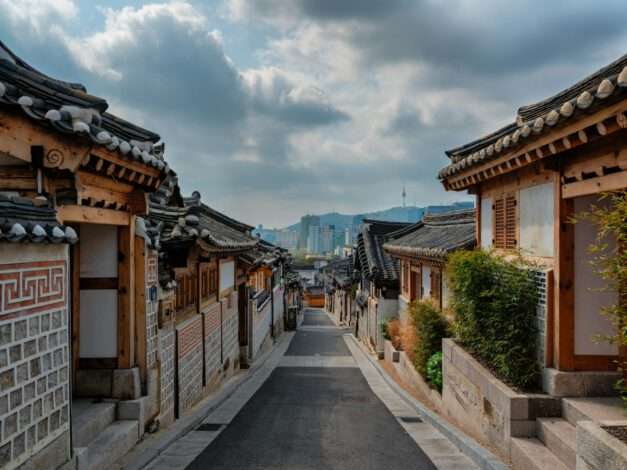
Bukchon does not announce itself loudly. It settles into the slope above the city, its tiled roofs bending gently upward at their corners, as if acknowledging the horizon without trying to compete with it. The lanes narrow gradually. Stone underfoot shifts in tone where rain has passed. Wooden doors sit slightly recessed, catching thin bands of light before slipping back into shade.
From certain angles, the shingles appear almost matte, absorbing the sky rather than reflecting it. Their repetition is steady but not exact. One roof curves a fraction higher than the next. Another dips subtly toward the alley. Nothing feels aligned by force. The houses seem to have adjusted themselves over time, following the incline rather than resisting it.
Sound behaves differently here. The larger avenues of Seoul recede. Footsteps echo briefly between plaster walls. The city remains present somewhere beyond, but in Bukchon it feels filtered, softened by wood and tile.
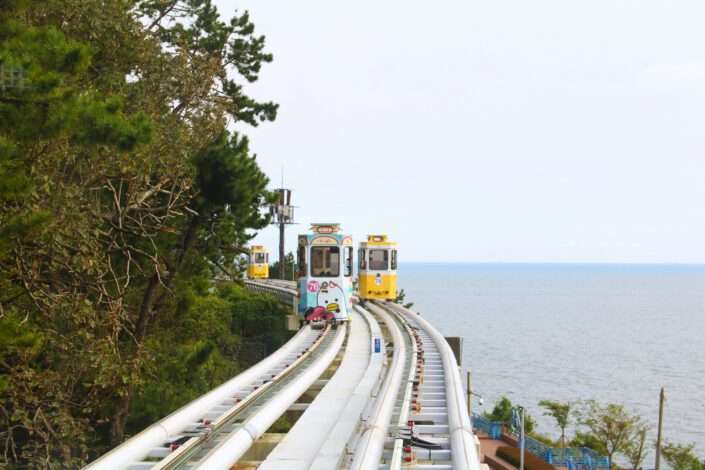
Where the Pattern Does Not Rush
Walking uphill, the repetition of rooflines becomes less architectural and more rhythmic. Curve after curve, shadow after shadow. Laundry shifts lightly in courtyards hidden from direct view. Small plants lean over walls without symmetry. The neighbourhood feels lived rather than preserved.
Later, travelling south on the KTX, the movement out of Seoul happens almost without notice. Buildings loosen their grip on the skyline. The river appears briefly, then fields, then distant hills gathering in layers. The train carries its own quiet momentum, steady rather than dramatic.
Through the window, the landscape arranges itself in long horizontal bands. Villages cluster near water. Highways intersect and separate again. The journey feels less like transition and more like continuation — rooflines giving way to ridges, urban density easing into open terrain.
Bukchon remains in memory as texture more than image: tile under shifting light, wood warmed by afternoon air.
Salt and Silver at the Water’s Edge
In Busan, the rhythm changes, though not abruptly. The city leans toward the sea. The air holds salt more distinctly. Jagalchi Fish Market stretches along the harbour, its stalls arranged in bright, practical rows. Crates, nets, and tanks gather near the waterline.
Inside, the atmosphere feels immediate. Fish laid over crushed ice shimmer faintly under fluorescent light. Buckets of shellfish shift as water circulates through them. Voices rise and overlap. The scent is unmistakable — brine, seaweed, something metallic and clean at once.
The stalls do not aim for symmetry. They operate through proximity. Narrow aisles wind between counters. Vendors gesture toward their displays without urgency. Outside, gulls move in loose circles above the harbour.
The sea remains only steps away, rising and falling in small increments against the quay.
Tile and Tide
Bukchon’s shingles absorb light quietly. Jagalchi’s stalls reflect it in fragments — scales catching brightness, metal surfaces flashing briefly before dulling again. One place leans inward along a hillside; the other opens outward toward open water.
Yet both rely on repetition. In Seoul, the arc of roof after roof creates a steady cadence. In Busan, the arrangement of stalls forms a different kind of pattern — crates aligned, tanks circulating, boats returning at regular intervals.
Neither setting feels curated for effect. The hanok houses remain functional spaces of residence. The market remains a working harbour exchange. Texture carries more weight than spectacle.
There are moments when the distinction softens. Late afternoon in Bukchon can feel almost coastal when wind threads through the alleys. Early morning in Jagalchi can feel briefly still before vendors and buyers fill the space.
After the Corridor Has Unfolded
Later, the two images overlap slightly. Roof tiles darken in recollection. Fish scales shimmer faintly without precise form. The line between hillside and harbour becomes less defined.
What remains is movement: the quiet glide of the train southward; the steady circulation of water in market tanks; the gradual shift from city interior to coastline. The Gyeongbu corridor stretches between them, less as a map than as a thread of light and terrain.
The shingles continue curving against the slope. The market continues facing the tide. And somewhere along that path, the air changes again — from wood and stone to salt and steel — without ever fully announcing the moment it did.
Check out our Travel Adventure videos below!