Enterprise sustainability reporting has moved from annual narrative work into controlled data production. For US companies with global operations, CSRD, ISSB, SEC climate and SBTi timelines now require sustainability, finance and risk teams to work from the same evidence base.
This ranking focuses on platforms that help large organizations centralize data, manage Scope 3 complexity, prepare disclosures and support audit-ready workflows. I looked at practical enterprise fit, not just the breadth of vendor claims.
Enterprise ESG reporting now depends on shared data, evidence trails and controlled disclosure workflows.
Key Takeaways
- Workiva fits finance-led ESG disclosure. It suits teams that need connected reporting, ESRS XBRL tagging, iXBRL validation and SEC controls in one environment.
- Sweep is a top pick for supplier data and Scope 3 workflows. It is well suited to teams that need to centralize sustainability data, collect supplier inputs and coordinate carbon-plus-ESG disclosure work.
- SAP Sustainability Control Tower fits SAP-centric multinationals. It is useful when sustainability reporting must align with existing SAP data models and global operating structures.
- Persefoni and Watershed are climate-led choices. Both are relevant when SEC climate, CSRD climate disclosures, CDP reporting and assurance preparation are near-term priorities.
- IBM Envizi and Diligent ESG cover broad governance needs. Envizi brings framework breadth, while Diligent connects ESG reporting with board oversight and GRC workflows.
- No platform guarantees compliance. The value is in evidence, workflow discipline, controls, review history and repeatable disclosure production.
How I tested these ESG reporting platforms
I treated this as an enterprise sustainability software shortlist, not a generic tools roundup. I reviewed public documentation, available demos, workflow descriptions and the disclosure capabilities each vendor publishes.
Regulatory readiness was the first filter. I looked for CSRD and ESRS support, iXBRL or XBRL workflow depth where relevant, SEC climate workflow support and ISSB alignment signals.
Data operations mattered just as much. I weighted Scope 3 coverage, supplier data collection, integrations, data ingestion, evidence management and the ability to move from raw inputs to controlled disclosures.
Enterprise fit was the final lens. I considered permissions, audit trails, version history, board reporting, finance collaboration and scalability across complex legal entities.
What counts as an ESG reporting and disclosure platform
An ESG reporting and disclosure platform should do more than store survey answers. At enterprise scale, it needs to centralize data, map it to frameworks, coordinate tasks, preserve evidence and produce disclosure-ready outputs.
Useful platforms also connect sustainability work with finance, risk, procurement and legal teams. That matters because CSRD, SEC climate and ISSB reporting depend on controlled inputs, not last-minute spreadsheet consolidation. For broader context on how sustainability decisions reach households and consumers, this lifestyle and sustainability resource can offer useful perspectives alongside enterprise reporting work.
Workiva
Workiva is a strong fit when sustainability disclosure sits close to finance, SEC reporting and formal controls.
Workiva pros
- Connected financial and sustainability reporting in one workspace
- ESRS XBRL taxonomy support for CSRD-aligned reporting
- iXBRL validation against EFRAG taxonomy files
- ESEF-ready authoring with table and in-text tagging
- SEC reporting stack with XBRL automation, validation and governance controls
Workiva cons
- Enterprise licensing requires careful scoping
- Configuration can be complex for first-time ESG teams
- Non-finance contributors may need change management
My experience with Workiva
I put Workiva first because it brings financial reporting discipline into sustainability disclosure work. The ESRS XBRL taxonomy support, iXBRL validation against EFRAG files and ESEF-ready authoring workflows help CSRD teams treat digital tagging as controlled work.
Its SEC reporting stack also gives finance teams a familiar environment for XBRL automation, validation, permissions and review history. I would use it where the disclosure process needs to stay close to finance controls.
Workiva pricing
Workiva pricing is quote-based and depends on modules, entities, user counts and tagging needs. I would scope CSRD, SEC and assurance workflows before comparing costs.
SAP Sustainability Control Tower
SAP Sustainability Control Tower is most relevant for enterprises that already rely on SAP for core operating data.
SAP Sustainability Control Tower pros
- Native alignment with SAP data and enterprise processes
- ESRS Starter Pack assets for operationalizing ESRS reporting
- Central hub approach for ESG reporting and CSRD programs
- Role-based dashboards for program oversight
- Clear fit for multinational master-data governance
SAP Sustainability Control Tower cons
- Value is clearest in SAP-centric estates
- Implementation effort can be meaningful
- Licensing may involve several SAP products
My experience with SAP Sustainability Control Tower
SAP Sustainability Control Tower makes sense when ESG data has to follow existing SAP process logic. The ESRS Starter Pack gives teams a more structured route into CSRD reporting requirements, especially where entities, plants and cost centers already sit inside SAP.
I would choose it for a complex multinational that wants sustainability reporting to inherit enterprise master-data discipline rather than sit beside it. The tradeoff is that the business case depends heavily on the SAP footprint already in place.
SAP Sustainability Control Tower pricing
SAP Sustainability Control Tower is enterprise, quote-based software sold through SAP and partners. Budget for implementation design, integration work and reporting process change.
Sweep
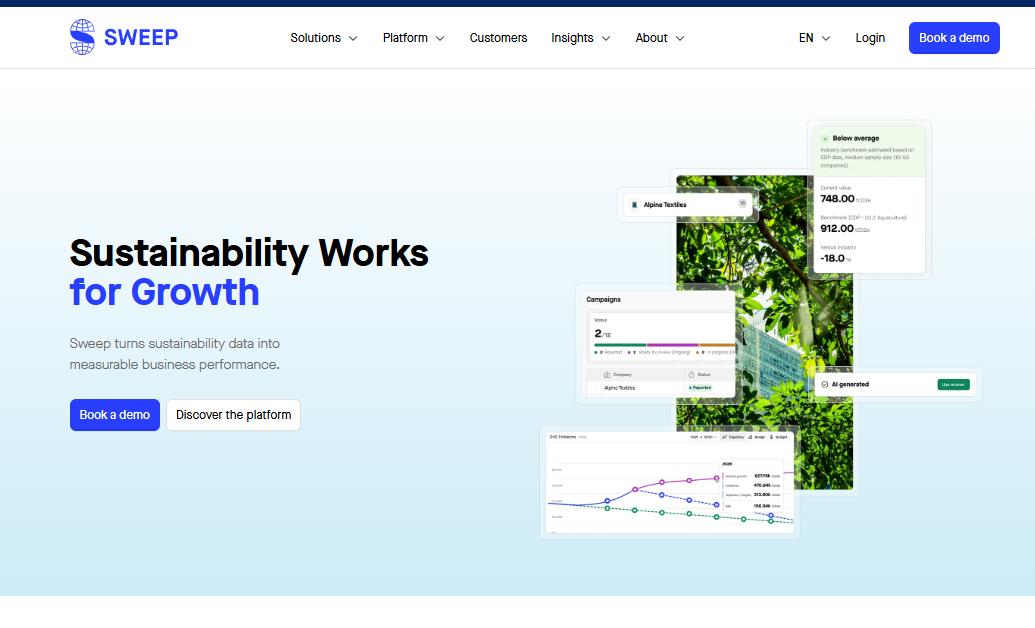
Sweep is well placed for enterprises that need sustainability intelligence across supplier data, carbon accounting and disclosure preparation.
Sweep pros
- Centralizes sustainability and carbon data in one platform
- Supports Scope 1, 2 and 3 management
- Collects supplier data in real time for value-chain visibility
- Helps consolidate disparate data sources into one measurement system
- Organizes ESG and carbon disclosure workflows
- Supports collaboration and audit preparation across teams
Sweep cons
- Pricing is not publicly listed
- It is a newer brand than long-standing finance suites
- Advanced non-carbon ESG domains may need configuration
My experience with Sweep
With Sweep, the main advantage I noticed was how directly it addresses the hardest data layer in enterprise sustainability work. Supplier responses, Scope 3 inputs and carbon datasets can be organized in one measurement system rather than passed through disconnected spreadsheets.
I see Sweep as a sustainability intelligence platform for CSRD, SBTi, SFDR, carbon and ESG reporting work. For me, it belongs in the best ESG Reporting and Disclosure shortlist when the priority is centralizing data, collecting supplier inputs and building evidence for disclosure.
I would still scope non-carbon ESG data carefully. Its collaboration model is well suited to CSRD preparation and audit evidence collection.
Sweep pricing
Sweep uses enterprise quotes, with packaging likely to vary by modules, footprint and data complexity. I would define supplier coverage, Scope 3 needs and disclosure workflows before requesting pricing.
Persefoni
Persefoni is a practical fit when climate disclosure is the center of the ESG program.
Persefoni pros
- Carbon accounting across Scope 1, 2 and 3
- SEC climate disclosure workflows aligned to governance and risk oversight
- CSRD-first sustainability reporting module
- Audit-readiness features including activity logs and approval locks
- Partner ecosystem for implementation and advisory support
Persefoni cons
- Carbon-first focus may require additions for broader ESG topics
- Complex value chains still require integration and mapping work
My experience with Persefoni
Persefoni works well when carbon data, climate governance and disclosure controls are the main challenge. I liked the emphasis on governance over data changes, because SEC climate work will test controls as much as calculations.
The CSRD reporting module adds useful structure for sustainability teams. ISSB and CDP support should be confirmed against current roadmap timing during procurement.
Persefoni pricing
Persefoni offers enterprise and tiered plans. Pricing should be confirmed by entity count, reporting boundaries, emissions scope and required disclosure modules.
IBM Envizi ESG Suite
IBM Envizi ESG Suite is relevant for global programs that report across several frameworks and stakeholder groups.
IBM Envizi ESG Suite pros
- Framework library covering ESRS, GRI, SASB, SFDR, UN SDGs and TCFD
- Centralized system for multi-framework ESG reporting
- Automated data capture for recurring inputs
- Evidence management and analytics for assurance preparation
- Survey capabilities for value-chain data
IBM Envizi ESG Suite cons
- Broad suite can feel complex
- Implementation and change management are required for global rollout
My experience with IBM Envizi ESG Suite
IBM Envizi is useful when breadth of framework coverage is a core requirement. The ability to manage ESRS, GRI, SASB, SFDR and other questionnaires in one place helps companies report to multiple stakeholders.
I would shortlist it for global programs that want centralized data capture, analytics and assurance preparation inside a larger IBM ecosystem. Teams should plan enough time for configuration and adoption.
IBM Envizi ESG Suite pricing
IBM Envizi is quote-based through IBM and partners. Scope the framework set, integration needs, number of sites and support model before budgeting.
Diligent ESG
Diligent ESG fits organizations where disclosure, board reporting and governance workflows need to stay connected.
Diligent ESG pros
- CSRD report authoring template inside the platform
- SEC climate workflows for data collection, reporting and automation
- API support for data ingestion
- Connection to board reporting and GRC workflows
- Clear governance context for directors and executives
Diligent ESG cons
- Some templates may feel fixed
- Deep EHS needs may require specialist systems
- Non-governance users need onboarding
My experience with Diligent ESG
Diligent ESG is useful when disclosure work and board oversight are closely linked. The CSRD authoring template gives teams a structured starting point, while SEC climate workflows support collection, reporting and automation.
I would consider it for organizations where ESG reporting sits inside a broader governance, risk and board communications agenda. It is less suited to teams looking only for a specialist EHS system.
Diligent ESG pricing
Diligent ESG pricing is enterprise-based and may be bundled within the wider Diligent platform. Confirm which ESG, GRC and board modules are included.
Watershed
Watershed is a focused option for companies building a climate-first disclosure program.
Watershed pros
- Assurance-ready climate data workflows with error checks
- CDP reporting through direct API sync
- Guided CSRD reporting with audit preparation support
- Anomaly detection for climate disclosure data
- Decarbonization planning tools
Watershed cons
- Climate-led approach may need complementary ESG systems
- Multi-entity consolidation still requires setup effort
My experience with Watershed
Watershed is a good fit when carbon accounting, disclosure quality checks and decarbonization planning need to sit close together. The CDP API sync is useful because it reduces manual transfer between reporting workstreams.
The guided CSRD reporting workflow emphasizes audit preparation, which matters for enterprise teams building control discipline. I would still confirm how broader ESG topics will be managed outside the climate program.
Watershed pricing
Watershed pricing is enterprise and quote-based. Scope by entities, reporting frameworks, assurance requirements and climate program complexity.
Conclusion
For enterprise buyers, the decision should start with reporting ownership and data bottlenecks. If finance owns the final filing, Workiva deserves close review; if supplier data and Scope 3 are the constraint, Sweep should be in the early evaluation set.
SAP, Persefoni, IBM Envizi, Diligent and Watershed each have a credible role for specific operating models. Match the platform to your reporting scope, evidence needs, integration reality and assurance timeline before committing budget.