76% of Americans 65 and older now own a smartphone. In 2013, that number was 18%. That’s not a gradual shift. That’s a full generational reversal happening in just over a decade, and most people writing about technology have completely missed it.
The conventional story treats older adults as reluctant, confused, or simply left behind by the pace of digital change. The actual data tells a different story. Seniors are not trailing younger generations anymore. In several key adoption metrics, they’re closing the gap faster than any other cohort. If you’re trying to understand where technology use is actually heading in this country, you need to start by looking at the 65-plus population.
The Numbers That Reframe Everything
The U.S. population age 65 and older rose by 3.1% to 61.2 million from 2023 to 2024, according to the Vintage 2024 Population Estimates released by the U.S. Census Bureau. That’s a massive and fast-growing segment of the population, and it’s the same group that the tech industry once wrote off as a niche market. Now pair that demographic surge with smartphone adoption data. According to a 2024 Pew Research Center analysis, 76% of those 65 and older now own a smartphone, reflecting a significant shift in the way seniors engage with digital technology. A decade ago, that figure sat below 20%. The speed of that climb is extraordinary, and it didn’t happen by accident.
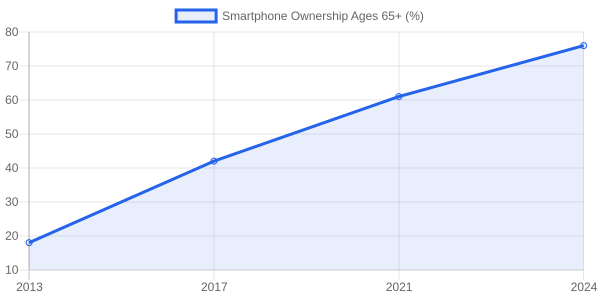
The chart above, built from Pew Research Center’s mobile technology fact sheet, shows four data points across eleven years. That upward arc isn’t noise. It’s a structural change in how an entire generation relates to technology.
What Actually Drove This Shift
Three forces pushed seniors online faster than anyone expected. Convenience was first. Video calling made it easier to see grandchildren across the country. Rideshare apps cut dependence on driving. Online grocery delivery arrived right when it mattered most.
Necessity was second. The pandemic forced millions of older adults into digital tools they’d been able to avoid before. A video appointment with a doctor, an online prescription refill, a text message to a neighbor when physical visits weren’t possible. Those weren’t optional upgrades during 2020 and 2021. They were survival tools.
Design was third, and it’s the one that gets overlooked. Manufacturers quietly made devices far more accessible over the past decade. Larger default text sizes, stronger speaker output, simplified home screens, and voice commands like Siri and Google Assistant removed the biggest friction points that used to make phones feel hostile to older users. The phone got easier. Senior adoption followed.
The Digital Comfort Curve: A Framework for Understanding Senior Tech Adoption
Here’s a pattern worth naming: the Digital Comfort Curve. Seniors typically move through four distinct stages when adopting a new device or app. First comes reluctance, which is rooted not in inability but in unfamiliarity and a low tolerance for wasted time. Second comes a specific trigger: a family member shows them one useful feature. Third is repetition, where that single feature gets practiced until it’s automatic. Fourth is expansion, where the senior starts exploring adjacent functions on their own.
Most tech education programs for older adults skip stages one through three and jump straight to a full feature demonstration. That’s why they fail. The Comfort Curve says: start with one thing that solves a real problem the person already has. Everything else follows from that.
Margaret, a 71-year-old retired teacher from Sarasota, didn’t want a smartphone at all until her daughter set up a shared photo album. Within six weeks, Margaret was using the same phone to check her medication schedule, video call her book club, and navigate to a new grocery store she’d never visited. The trigger wasn’t tech enthusiasm. It was a specific, personal need. The Comfort Curve did the rest.
Where Seniors Are Still Behind (And Why It Matters)
Closing the gap doesn’t mean erasing it. Although 76% of older adults now own smartphones, 17% of seniors still have a cell phone that lacks apps and web-browsing capabilities, according to the latest Pew Research Center data on tech adoption trends. That remaining group skews older, rural, and lower-income. They’re not resisting by choice. Connectivity costs, physical limitations, and a lack of hands-on support explain most of it.
This gap matters beyond individual convenience. As more services move online by default, from government benefits portals to telehealth scheduling to prescription management apps, the seniors without reliable internet access or capable devices get cut off from resources they’re entitled to use.
“How well you and your doctor talk to each other is one of the most important steps to getting good health care.”
National Institute on Aging, U.S. Department of Health and Human Services
That observation from the National Institute on Aging’s guidance on patient-provider communication applies directly to the digital access question. When older adults can’t use the same communication channels their providers offer, the quality of that relationship gets harder to maintain regardless of how good the clinical care is. Practices that recognize this invest in phone-based scheduling, printed summaries, and staff who can walk patients through a patient portal step by step. Senior care at Suncoast Family Medical Associates reflects this kind of integrated approach, where digital tools support the care relationship rather than gatekeeping it.
A Practical Guide to Helping a Senior You Know Get More From Their Phone
If you have a parent, grandparent, or older neighbor who’s struggling with their device, this four-step approach works better than a tutorial session.
- Ask what problem they want to solve. Not what feature you think is cool. Their real, current problem. Navigation, staying in touch with family, checking the weather before they walk outside.
- Set up one thing completely. Don’t explain how it works. Just make it work. Then show them how to start it again themselves.
- Write the steps down on paper. A laminated index card beats any YouTube tutorial for this age group. Physical reference material builds confidence faster than memory.
- Check in a week later. Not to teach more, but to troubleshoot whatever broke in their mind since you left. That second session is where real retention happens.
Patience pays. The Comfort Curve is real, and every stage of it takes time.
What the Adoption Data Means for the Next Five Years
The senior population isn’t just growing. It’s growing into a cohort that’s already digitally comfortable. The number of Americans ages 65 and older is projected to increase from 58 million in 2022 to 82 million by 2050, a 42% increase, according to the Population Reference Bureau. That’s 82 million people, most of whom will have spent 10 to 20 years using smartphones by then.
| Year | Smartphone Ownership (65+) | Source |
| 2013 | 18% | Pew Research Center |
| 2017 | 42% | Pew Research Center |
| 2021 | 61% | Pew Research Center |
| 2024 | 76% | Pew Research Center |
The trend line in that table isn’t slowing. If anything, it accelerates as the youngest baby boomers age into the 65-plus cohort carrying lifetimes of device familiarity with them. The seniors of 2035 will have grown up with the internet. Planning for them as if they’re the seniors of 2005 is a mistake the tech and service industries can’t afford to keep making.
The real question isn’t whether older adults can use technology. They already do. The question worth asking now is whether the systems built around them are keeping pace.

Meg is an author at Cinnamon Hollow. She writes on a variety of topics sharing tips and ideas for daily life.